

Farewell 2025—But Also, Like, What the Hell Just Happened?
Amber Bennett, Executive Director
Like many of you, we spend our days talking about climate change. This year, we had hundreds—likely thousands—of conversations with people in the headlines, on the frontlines and in the backrooms of Canada’s climate field.
Across those conversations, one thing came through consistently: communicators are trying to make sense of what’s happening and how to re-orient during a rapidly shifting climate policy and political landscape.
What is clear is that communicators are grappling with rising disinformation, political backsliding, shifting public priorities and a profoundly changed information environment.
And there are troubling signals in the system. Climate silencing is real. Fatigue is setting in. Basic public understanding of the causes, impacts and solutions to climate change is slipping. And we’re seeing a noticeable uptick in the belief that climate change is exaggerated—or even a hoax.
And yet, alongside those warning signs, we see something else that matters just as much.
Concern about climate change among Canadians remains high—very high. And they believe that we can do something about it.
Canadians care. What they want is a response that actually matters.
(con’t below)
Re.Climate’s 2025 publications



Four Gaps That Have Our Attention
While Canada’s climate conversation didn’t disappear this year, it did become quieter, more fragmented and harder to sustain. Taken together, the research and our conversations point to four gaps that should give any communicator pause.
1. The Perception Gap
The problem in Canada isn’t apathy, at least not for most people. It’s that we believe we’re far more embattled, fatalistic and disengaged than we actually are. The gap between what people feel privately and what they think others believe is significant—and it’s shaping beliefs and behaviour. And when the public doesn’t appear to care—or isn’t seen to care—there’s little incentive for leaders to act.
2. The Information Gap
Simply put: we’re not breaking through. Information and influence flow very differently than they once did. Institutions and advocates are no longer the primary brokers of information. That system has collapsed. Influence has shifted to personalities, networks and algorithms—and institutions have been too slow to adapt.
3. The Emotional Gap
As Canadians face a growing sense of precarity, we still too often meet them with talk of emissions targets and net-zero pathways and fail to build emotional connection and authenticity. Support for climate policy weakens when solutions feel ineffective, unfair or disconnected from material reality. (And while we’re here: can we try dialing down the earnestness and dialing up the fun? No guarantees—but it beats being miserable.)
4. The Literacy Gap
Canadians are increasingly recognizing climate impacts for what they are—but fewer than half can name the primary cause of climate change, and fewer still can name a single policy. This gap is widening.
These gaps are interconnected and self-reinforcing—and they point to where our focus must be.
How can we expect people to support something they barely hear about, rarely talk about, and don’t fully understand?If we want durable public policy, and actual change, communications and engagement have never mattered more.
What This Moment Is Teaching Us
If 2025 taught us anything, it’s that we can’t communicate about climate the way we used to. We can’t assume that more technical explanation will carry the day. Perception will beat math every time.
For years, climate narratives leaned heavily on moral urgency, emissions targets and global commitments. Those still matter—but on their own, they’re no longer enough. Canadians are navigating affordability pressures, institutional distrust and political polarization.
The public isn’t looking for wonky policy details. Technical policy matters—but it’s not a public engagement strategy. People want coherence and meaning. They want to understand not just what we’re doing, but why. Our role is to make that why unmistakable—and to build a public story that makes climate action feel both necessary and possible.
If expertise is going to matter, we need to rethink not just our messages, messengers and channels, but our actual underlying theory of influence.
This shift won’t happen overnight—but it’s already shaping how we think about the work ahead.
Looking Ahead: What We’ll Be Focusing on in 2026
In the year ahead, our work will continue to focus on community engagement in the age of influence, climate journalism, adaptation, clean cities, misinformation and narrative change—all in service of helping Canadians understand what a climate-safe future actually looks like, and the practical choices communities will face along the way.
Several major Re.Climate projects we’re especially excited about will shape this work:
- Theory of Influence
- Advancing a clearer understanding of how information, trust and legitimacy now move, and what communicators and institutions need to do to adapt.
- Climate Ready Prairies
- Completing a three-year pilot program on climate adaptation communications and engagement training in the Prairies, culminating in a practical, practitioner-focused guide.
- Clean Cities Research
- Delivering guidance and training—based on new research with EcoAnalytics—to help municipalities and their partners communicate clearly about strengthening community resilience and better buildings.
- Narrative and Audience Insight
- Deepening and expanding insights from the Five Canadas segmentation, with a focus on energy choices and climate adaptation.
- Getting to Yes
- Publishing research on how communities can build support for renewable energy and large-scale transmission.
- Misinformation
- Developing tools and training with municipal partners to help anticipate and respond to climate-related misinformation.
- Messenger Training
- Expanding pilot programs that equip trusted, locally rooted messengers to engage their communities on climate change.
- Climate Journalism
- Collaborating with the Canadian Association of Journalists to strengthen fact-based, engaging climate journalism across Canada.
Across all of this, we’ll continue to host the conversations and webinars you value—while placing greater emphasis on free and tailored training, evidence-based advice, peer learning, and pilot projects designed to reduce risk, build confidence and help institutions feel safe trying new approaches.
With Gratitude
As the year comes to a close, we want to say thank you.
To the collaborators, communicators, researchers, students, and funders who showed up to wrestle with hard questions and try new approaches. And to the Re.Climate team—for their care, creativity, and persistence.
So here’s to what comes next, we hope to see you there.
Our Impact in 2025
Webinar Reach
Growth in Network Members in 2025
Network Members
Events and publications
In 2025, we published 4 major publications and held 7 webinars with a total reach of 6,610.
Average Event Rating (out of 10)
PUBLICATIONs
- Communicating Climate and Affordability (Playbook)
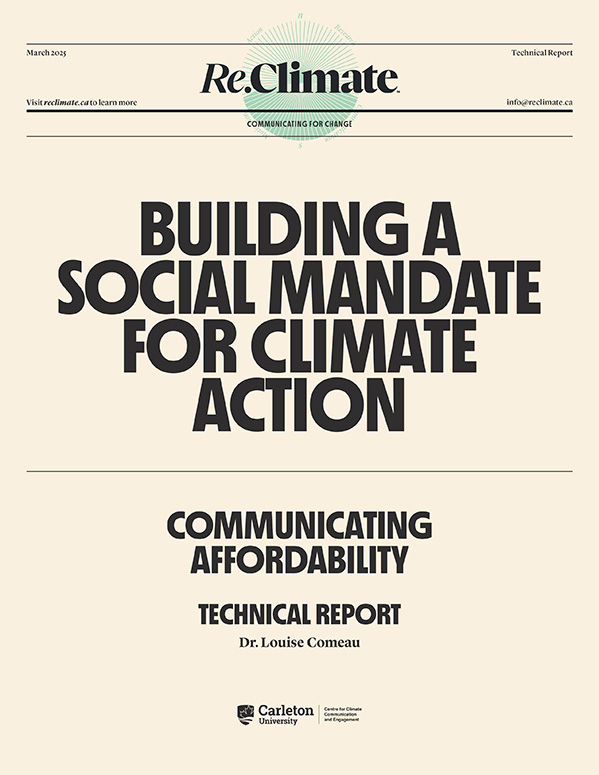
- Communicating Climate and Affordability (Technical Report)
- What Do Canadians Really Think About Climate Change? 2025
- Climate Change and Policy Rollbacks in Canada’s National Media
Webinars
Testimonial
“I really enjoyed being a part of such an engaging training session. I learned so much and am so excited to incorporate these teachings into my work, and even more excited to continue learning from you in our upcoming virtual sessions.”
Re.Frame Blog
In 2025, we launched the Re.Frame blog, a new space for bold thinking and practical tools to help shift narratives and grow public support for climate action. Re.Frame features the latest research, polling, stories from the field, and lessons learned by those working to move the needle.
Our top 5 blog posts had over 7,000 views in 2025
MOST POPULAR BLOG POSTs IN 2025
- What Do Canadians Really Think About Climate Change in 2025?
- The Five Canadas: Engaging Canadians on Climate Change
- Placing People at the Centre of Climate Change: Lessons from Siila Watt-Cloutier
- Talk, Baby, Talk
- Conservative Leaders are Failing to Respond to the Climate Concerns of their Base