

Most Canadians are worried about climate change — they just don’t know that most Canadians are worried about climate change.
The numbers are clear. A 2025 Abacus Data survey done in partnership with Re.Climate found that 64 per cent of Canadians want leaders to keep their climate change promises. Seventy per cent believe polluters should be regulated and 75 per cent are concerned about climate change. That’s over 31 million people. Even though residents are less concerned in Saskatchewan and Alberta, they still form a majority: 70 per cent in Saskatchewan; 68 per cent in Alberta.
The problem is, we don’t see this majority in our daily lives or in public opinion. That same survey showed that 42 per cent of Canadians think about climate change once a week, but that same group thinks only 33 per cent of Canadians and 26 per cent of their neighbours do the same.
As the numbers show, that’s clearly not true. This is called the “perception gap.” And if Canadians assume they are alone in their concern about climate change, they are less likely to talk about it.
Mis- and disinformation fills that gap and gets to steer the conversation—leading to troubling results, like 32 per cent of Canadians believing the effects of climate change are seriously exaggerated—meaning that some of the same people who are concerned about climate, are having their concern dismissed.
In an effort to restart climate conversations, Re.Climate held a webinar in April 2026, all about how to break this climate silence and help Canadians understand that they are not alone and, together, we can ensure a safer future for ourselves and the next generations.
Missed the webinar? Watch the recording here.
View the webinar presentation here.
Check out the guide here.
Our panellists came from all across the spectrum of everyday climate communicators
- Dr. Briony Latter is a research associate at the Centre for Climate Change and Social Transformations (CAST) at Cardiff University, studying how hairdressers can start climate conversations with clients.
- Sarah Lazarovic is a communications strategist who has worked on campaigns normalizing electrification.
- Angela Keller-Herzog is the executive director of Community Action for Environmental Sustainability (CAFES), a grassroots organization advocating for municipal climate action in Ottawa.
- Kyle Pope is a co-founder of the global journalism collaboration, Covering Climate Now, dedicated to increasing climate coverage in the media.
Why is it scary to talk about climate change?
Even for those passionate about climate action, it can be hard to talk about it. Why? Dr. Latter explained that the issue is social norms. These are informal, often unspoken rules that can determine our behaviour.
For example, not talking about politics at the dinner table? That’s a social norm. Apologizing all the time? That’s a Canadian social norm.
When we don’t hear people talking about climate change, Dr. Latter said, it becomes much harder for us to see it as normal and something we should all do. Importantly, social norms aren’t created by talking about something once. People need to hear these conversations over and over again.
But right now, talking about climate isn’t very normal. It can also bring up tough emotions like anxiety or a sense of helplessness.
As Keller-Herzog aptly put it, “You can see people shying away from talking about this. People protect their own well-being by changing the subject.”
Make climate visible

Luckily, the first step to breaking the climate silence doesn’t even have to be a conversation.
“We need to show people they can do this. We need to make our concern visible,” said Lazarovic.
In some of her campaigns, she has used buttons and lawn signs to make personal actions visible to others.
“I’m a huge fan of putting that heat pump in front of your house,” said Lazarovic, “because if it’s in the back, no one knows, but if it’s in the front of your house, we can all see that you’re doing this, and it’s becoming a real thing.”
When Dr. Latter worked with hairdressers, she noticed that hair salons also displayed posters, awards, and environmentally friendly cleaning products, showing the climate actions the salons were taking. These also gave the signal that this was a safe place to have a climate conversation.
Making visible action can lead to a positive snowball effect.
“The narrative in the media is that [climate] is a narrow fringe interest and that is not true,” said Pope. “If you realize that most people care about this, it changes your perception and makes you feel more comfortable talking about this.”
Make climate actionable
Just talking about climate change can make the issue seem pretty abstract.
If you know that people are concerned about climate change (reminder: most people are!), “skip that part,” suggested Keller-Herzog, and get right to taking action.
When she’s talking to local councillors, Keller-Herzog skips the term “climate change” altogether.
“We talk about rural transportation, the cost of building, energy efficiency, air quality, flooding, insurance premiums, whatever. It’s the same action that we want from them, but it’s a different doorway that we’re entering through.”
“This is the reason I gravitated towards electrification,” added Lazarovic. “I look for actionable, one-and-done solutions, because in a world where we have so much fatigue and overload, asking people to make so many little decisions can be overwhelming.”
Making things concrete and actionable can also help you pitch to reporters, who are always looking for a new lens through which they can tell a story.
“When COVID hit, every story had a COVID angle,” said Pope. “We need to think of climate the same way. We can talk about immigration or affordability, for example, through a climate lens.”
The importance of making climate conversations small talk
Hairdressers might not be the first people that come to mind when you think about climate communication
Yet, they are trusted by their clients, who sometimes have years-long relationships with their hairdressers.
Dr. Latter describes them as “everyday influencers.”
“Hairdressers are really experts at how to read clients, just in general, not necessarily specifically related to sustainability and climate change, but really trying to figure out their interests are, whether to move on from a certain topic,” said Dr. Latter.
The term “everyday influencers,” coined by her colleague Dr. Sam Hampton, helps distinguish between people like hairdressers, whom many of us interact with on a semi-regular basis, and “influencers,” whom we tend to imagine as “being really high profile, very visible people, celebrities and on social media,” said Dr. Latter.
It’s a helpful distinction to make, because there can be many different kinds of trusted messengers depending on context, topic and, of course, the person you’re talking to.
UK-based Climate Outreach defines a trusted messenger as reliable, honest, human and kind.
“So that could be a whole bunch of people,” said Dr. Latter. “It’s not necessarily those high-profile influencers. It can be friends, family, colleagues, neighbours, as well.”
Focus more on relationships, less on being the expert
Often, people are wary of bringing up climate change because they feel they aren’t experts on the topic.
This was what motivated Sarah Lazarovic to start the “Talk Climate To Me” program, which gives women resources to feel more confident talking about this issue.
But you don’t have to be an expert to share your passion and concern. By thinking beyond subject matter expertise, a whole world of new “everyday influencers” opens up to you.
For example, Covering Climate Now has started working with high school journalists as hyper-local messengers on climate.
“Students who work for their high school newspaper, who are really interested in covering climate, they do it at the very local level, even on campus,” said Kyle Pope.
“It’s frankly such an uplifting story about how engaged these kids are, the ideas that they have, and how willing they are to push this forward.”
Angela Keller-Herzog has also had success expanding climate conversations into rural areas by working with churches.
“Last year we did a series of concerts. Two young musicians had climate-themed concerts at churches. Making those connections has actually really worked for us and helped find our friends in rural areas, not necessarily in the climate bubble.”
So what are our panellists’ final tips on breaking the climate silence?
- Make it very local and very personal.
- Find the everyday influencers in your community—maybe it’s you!
- Connect the person in front of you to an action within their reach.
- Just start. Even if you’re scared. You’ll get ideas for improving on the next one.
Read the Guide
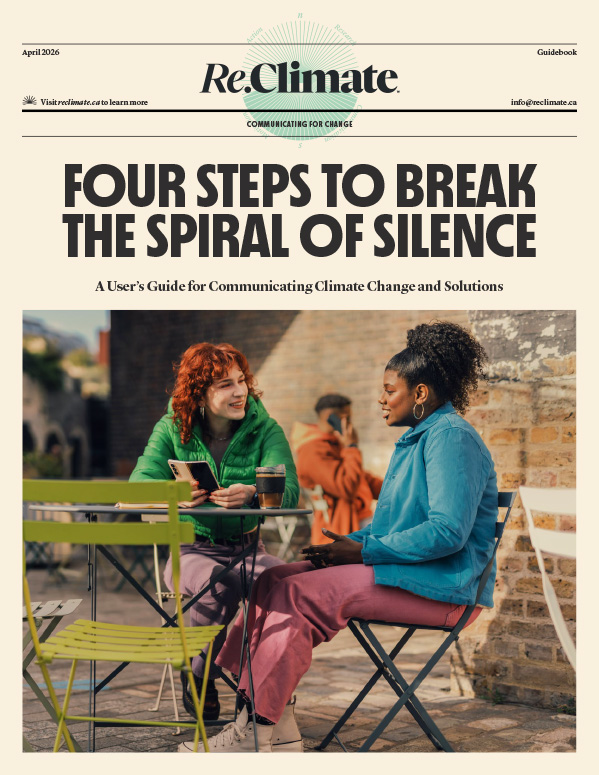
Read our guide “Four Steps to Break the Spiral of Silence” for more tips on how you and your community can make talking about climate change as normal as a Canadian apology.
Watch the Webinar
Follow along with the webinar presentation here.
