

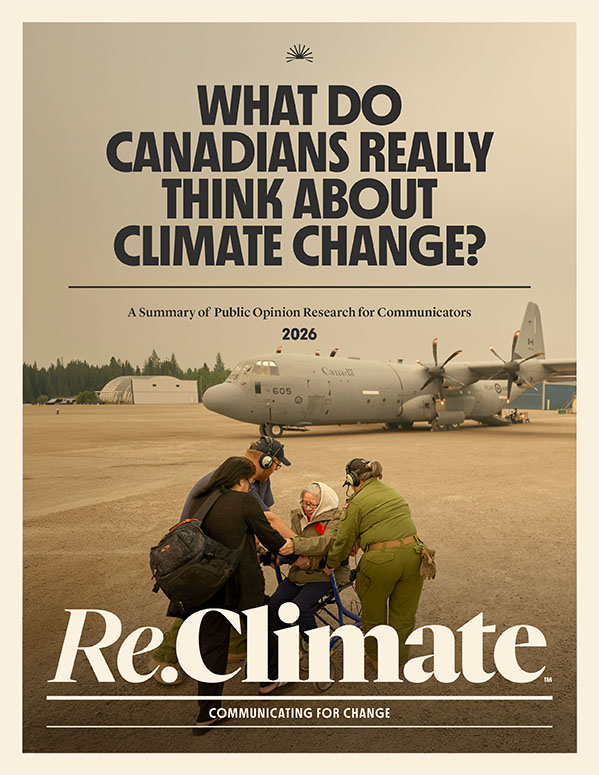
The trend continues: Canadians are deeply worried about climate change. In fact, polls show 80 per cent of Canadians are worried about climate change and its impacts. But this concern is not translating into action. With the cost of living, Donald Trump and the economy taking top priority, climate change has now become a “third-tier” issue, according to Re.Climate’s 2026 public opinion rollup, which aggregates over 100 polls from the past year conducted by Re.Climate and other organizations, to determine enduring and emerging trends in climate opinion.
Read the report here.
Missed the webinar? Watch the recording here.
View the webinar presentation here.
Priority is dropping, literacy is declining
Not only is climate change at the back of people’s minds, but one of the most troubling trends identified in this year’s report is the decline in Canadians’ ability to identify fossil fuels as the main cause of climate change.
“This represents the mental model the general public holds that leads to what they think should be done,” said Chris Hatch, one of the co-authors of the report.
In fact, the percentage of Canadians who believe climate change is caused equally by human activities and natural changes has been increasing. Forty per cent of Canadians agreed that climate change was caused by equal parts human activity and natural change. Meanwhile, only 49 per cent can correctly identify burning fossil fuels as the main cause of climate change.
“When you think about how much of the public debate has been around pipelines, oil and gas and coal in general, it hasn’t really stuck for a lot of people that fossil fuels are causing climate change,” said Hatch.
This is especially concerning given the federal government’s latest accounting for Canada’s greenhouse gas emissions shows that the oil and gas sector accounts for 30 per cent of Canada’s total emissions and will rise as production increases.
In parallel with the decline in climate literacy, the number of Canadians who say climate change is a hoax has increased. Spark Advocacy, a public affairs agency, found that 46 per cent of Canadians under 30 said climate change is a hoax, an uncomfortable number given that people believe that young people care more about climate change than their older peers.
“We assume young people are now uniformly climate champions,” said Sonja Solomun, an assistant professor at McGill University and the deputy director of the Centre for Media, Technology and Democracy.
“More than three-quarters of young people said climate change affects their mental health, but underneath that there’s this pocket of rising skepticism that’s concentrated among young men who are the most doubtful that action even works.”
Read the Report
How did we get here?
It’s easy to see these trends and feel only despair. But it’s important to understand what’s leading to these opinions and how durable they are.
In her commentary in the rollup, Dr. Amy Janzwood, a political science professor at McGill University, noted that politicians have long claimed that Canada can build pipeline infrastructure while taking climate action. It wasn’t long ago that former Prime Minister Justin Trudeau was justifying the federal government’s purchase of the Trans Mountain pipeline with the promise that fossil fuel revenues could help fund the clean energy transition.
Even though many people say they support a pipeline in theory, that support often depends on the details and may fade once a specific project is proposed.
Hatch noted that no surveys were found with opposition to a pipeline above one quarter, but support drops significantly once additional factors come into play.
“If the government is proposing to bypass environmental reviews, support drops below half. Opposition by provinces or First Nations, all these drop support below half,” said Hatch.
The decline in climate literacy also speaks to a larger problem of how and where Canadians get information about climate change.
“Roughly half of Canadians can’t reliably tell true climate information from false, and the way people rely on mainstream coverage of this has been really stripped of that context and the information they need to be able to make that distinction,” said Solomun.
A lack of contextual, non-partisan information on climate change or climate action, coupled with the sense that they are alone in their concern, has led Canadians to adopt doomism and disengage from the issue as a way to cope.
“One important finding, which we highlighted in our last two webinars, is that we have a big perception gap in Canada,” said Ghadah Alrasheed, Resource and Training Director at Re.Climate and report co-author.
“Forty-two per cent of Canadians say they think about climate change more than once a week, yet they believe only 26 per cent of their neighbours do the same. That’s a 16-point perception gap. This really matters because perceptions of social norms shape what we talk about and what we stay silent about. If people assume that climate concern is uncommon, they are less likely to raise the issue.”
So to hammer it home: 80 per cent of Canadians are concerned about climate change. Support for renewable energy build-out, especially of solar and hydro power, has been steady for years. Even onshore wind has 60 per cent support nationwide. The challenge for communicators now is to make this climate concern and climate solutions visible across platforms, demographics and regions.
Recommendations for communicators
1. Combat illiteracy with visibility
It’s clear that Canadians do care about climate change. It’s just that, as Chris Hatch said, “the public has been broadsided—by energy shocks, inflation, now we’ve got war in the Middle East—over and over, and just has more immediate priorities right now.”
To close the perception gap and build a mandate for action, communicators need to show Canadians the positive climate action happening in their own communities and even around the world.
“Forty-four per cent of people globally understand international climate negotiations like COP,” said Alrasheed, “but awareness in Canada is roughly half of that. So we need to highlight that climate concern is really common and that the world is actually moving on with climate action.”
This will also show people what choices they have when it comes to taking climate action, which can push back against the feeling that they have no options.
2. Don’t skip the basics
Sadly, it’s still not common knowledge that burning fossil fuels like oil, gas and coal is the primary cause of climate change. But we can change that by hammering on the basics.
“As you tailor your message to various audiences, don’t forget the basics: fossil fuel burning causes climate change,” said Hatch. “The narratives that really resonate are those really simple basic messages repeated thousands and thousands of times that eventually become the basis for people’s attitudes.”
3. Lean into values
Climate change is harming the places and people we love. Tap into Canadians’ love of nature, concern for future generations and their values of fairness and accountability (for more on this, see Re.Climate’s report Fair or Fail) so they can feel engaged and seen in your communications.
“Concern for nature is part of the Canadian identity, and actually, a lot of Canadians think of that as part of their national identity, and we centre it on protection of places and nature, animals and plants,” said Alrasheed.
4. Build bridges with different online communities
If your work happens on social media, then one way to get out of the climate bubble is to work with what Sonja Solomun calls “bridge creators.” These creators can help spread messages to different audiences across platforms like YouTube, TikTok, and Instagram, reaching people who consume different types of content and might not otherwise see the same information.
“The cooking and fitness channels, the parenting channel, the hockey creator who reaches people who’d never overtly click a climate post are going to be really key here,” said Solomun.
Everyone, everywhere, all at once
Yes, it is critical to tailor your messaging to specific audiences. But the takeaway from our webinar was that no matter how we tell it, we need to tell the story of what causes climate change and what we can do about it over and over again.
“I think that whenever we can, we need to provide as complete a narrative as possible: the problem, who’s causing it and the pathway forward in every communication,” said Hatch.
“I think stories that focus on that aspirational future identity versus this current petro-nationalist identity, where economic safety and security are directly linked to the fossil fuel industry, are going to be a hopeful path out of this,” said Solomun.
“We want to focus more and more on that hope,” added Alrasheed, “but also invest in more climate education, in history, community impacts, climate solutions and avenues for action, and this should be everybody’s responsibility.”
Read the report for more
Read Re.Climate’s full 2026 report: What Do Canadians Really Think About Climate Change? and find more recommendations to support your communications work.
Watch the Webinar Recording
Follow along with the webinar presentation here.
